
Arthurian legend, Offa’s Dyke and a lobby exhibition proposal for Knucklas Community Centre

Update 1. 19 Nov. 2025 – The stolen Heyope Torcs
In late November 2025, the neighbouring village of Heyope awoke to the news that the three Heyope gold torcs had been stolen after more than half a century on peaceful museum display. Replicas of these three torcs, (the originals discovered by local schoolgirl Wendy Davies), had been imagined as the “star” artefacts of the Knucklas lobby exhibition, standing for both the deep time of borderland craftsmanship and the fragile nature of shared heritage. Their disappearance is a reminder that the “war” against cultural theft and destruction now plays out not just on battlefields, but in galleries, archives and small rural museums.
For the “Borders at Peace – The Marches Journey” project, the theft adds a bittersweet layer. A display that set out to show how the Marches had moved from war to peace must now also acknowledge that peace is never entirely secure, and that communities must actively protect the stories and objects that hold their identity. Yet there is also a quiet metaphor here: if the torcs have indeed been melted down and merged, they might now exist as unseen circles of metal travelling the world, an unintended symbol of cultures fusing and re‑forming rather than remaining locked in one place.
Update 2. 04 Feb. 2026 – Offa’s Dyke as both a linear “town” & green corridor
Another strand that has grown from the original Knucklas proposal is the idea of re‑imagining Offa’s Dyke not only as an ancient earthwork, but as a kind of elongated “green town” for nature’s community. Just as the people who built and managed Hadrian’s Wall or the Great Wall of China effectively created continuous settlements along those defensive lines, so too did generations of families, traders, soldiers and farmers live, work and move along the Dyke.
This perspective also links the Dyke to the older pattern of communities forming along rivers for water and transport, and later along roads as strip developments where early services clustered. Water flows downstream from a spring, sewage flows away from a community, goods and people move along tracks and tarmac – and culture travels with them.
The Knucklas lobby display can use this idea of Offa’s Dyke as a green border ‘linear-nature-town” to connect local stories to other corridors: the River Teme; roads and rail verges; footpaths; drover (bridle) tracks. The sea at both ends of Offa’s Dyke connect it with maritime green-corridors to link the World, naturally.
And as far as the World’s presently contested frontiers, maybe the Marches is one small and hopeful model for how such borders might journey from war towards peace.


Overlooking Offa’s Dyke and the “green mound” of Knucklas Castle, this proposal imagined a small, seed‑like display in the community hall lobby. It would use the Arthurian stories of Arthur and Gwenhwyfar at Knucklas, the long history of the Marches as a border war‑zone, and the peaceful present of this landscape to explore how borders move from war to peace.
At its heart sat two ideas:
-
That Knucklas (“green mound”) itself symbolises nature and wildlife slowly reclaiming a castle of war and returning it to pre‑war peace.
-
That the Marches, once a frontier of conflict, can now act as a model for how borderlands elsewhere – from Gaza to Ukraine to the US–Mexico border – might imagine their own journeys from division to coexistence.
In Knucklas, this global web of Arthurian references returns home to a single hill and a single castle mound, offering a powerful way to root worldwide legend in a very local place.
The following Arthur timeline and Knucklas tale were designed both as storytelling material for local events and as interpretive text for that proposed lobby display.
The Arthurian legends have captured the imagination of people for centuries, inspiring countless tales of valor, chivalry, and the search for the legendary King Arthur. Although much of Arthur’s story remains shrouded in mystery and folklore, historical references to this iconic figure have appeared in texts throughout Europe and beyond.
This timeline aims to trace the evolution of Arthurian references from the earliest known mention in a Roman document about a warrior in Britain to the most recent texts that continue to perpetuate these captivating legends.
Timeline of Arthurian References:
- 6th Century – The Annales Cambriae (Welsh Annals):
- Mention of the Battle of Badon Hill, associated with Arthur.
- Location: The exact location of Badon Hill remains debated, but it is generally believed to have taken place in the West Country of England.
- 9th Century – Historia Brittonum (The History of the Britons):
- Detailed account of Arthur’s twelve battles:
- Battle of the River Glein
- Battle of Dubglas
- Battle of Bassas
- Battle of Cat Coit Celidon
- Battle of Celegion
- Battle of Guinnion Fort
- Battle of Agned Hill
- Battle of City of the Legion
- Battle of Tryfrwyd
- Battle of Conisbrough
- Battle of Ciltre
- Battle of Badon
- Locations: The specific locations of these battles are not well-documented.
- Detailed account of Arthur’s twelve battles:
- 12th Century – Geoffrey of Monmouth’s “Historia Regum Britanniae”:
- Introduction of Arthur as a legendary king, Excalibur, Merlin, and the Holy Grail.
- Origin: Geoffrey’s imaginative work contributed significantly to the development of Arthurian legends.
- 12th Century – Chretien de Troyes’ Arthurian Romances:
- Introduction of elements like the Round Table and Lancelot.
- Origin: These romantic tales added depth to Arthurian lore.
- 15th Century – Sir Thomas Malory’s “Le Morte d’Arthur”:
- Compilation of Arthurian stories.
- Origin: A comprehensive work that brought together various Arthurian narratives.
- Tintagel Castle:
- A legendary location associated with the birth of King Arthur.
- Origin: The connection to Arthur comes from Geoffrey of Monmouth’s writings in the 12th century.
- Legend of Princess Gwenefar of Knucklas:
- A legend tells the story of Princess Guinevere (Welsh: *Gwenhwyfar ; Breton: Gwenivar, Cornish: Gwynnever) of Knucklas marrying Arthur the Welsh warrior in Knucklas Castle.
- Origin: This legend is not widely documented in historical texts but remains part of local folklore and oral tradition in the region.
For the Knucklas Community Centre lobby exhibition, this legend of Gwenhwyfar of Knucklas and Arthur the Warrior was to anchor the “Borders at Peace” story: a local marriage tale set at a former frontier, standing for the possibility of culturing cwtch at borders everywhere.
- 12th Century – France – “Lancelot, the Knight of the Cart” (Lancelot, le Chevalier de la Charrette):
- This French romance by Chretien de Troyes introduces Lancelot as one of the key figures in the Arthurian legend.
- Origin: Part of the Arthurian Romances by Chretien de Troyes, this story contributes to the Arthurian tradition in French literature.
- 13th Century – Italy – “Tristan and Isolde”:
- The tale of Tristan and Isolde is closely linked to the Arthurian world and is significant in Italian literature.
- Origin: While not an Arthurian text, it is a romance that often intertwines with Arthurian legends.
- 14th Century – Portugal – “The Legend of the Round Table”:
- An Arthurian adaptation by the Portuguese writer João de Barros.
- Origin: Reflects the Arthurian influence on European literature, even in countries like Portugal.
- 19th Century – Russia – “The Tale of the Knight Tri Sestrychki” (The Tale of the Three Sisters):
- An Arthurian-inspired Russian fairy tale.
- Origin: Demonstrates the global reach of Arthurian legends, even in Russian folklore.
- 21st Century – Global Adaptations:
- Contemporary literature, films, and television series around the world continue to adapt and reinterpret the Arthurian legends, showcasing their enduring appeal.
Conclusion:
These references in Britain, France, Italy, Portugal, Russia, and other parts of the world highlight the far-reaching influence of Arthurian legends on global literature and storytelling. While the core of the legends is rooted in British tradition, they have transcended borders and continue to captivate audiences worldwide serving as a universal symbol of transformation and the potential for redemption that resonates across cultures.
Telling the Story of Arthur at storytelling events
As part of the proposed Knucklas lobby display, the story of Arthur would also be told live at community events, especially for children, at the foot of the original green hill:
“So the story goes … in a land filled with castles and mystery, there lived a legendary warrior named Arthur. Arthur was known far and wide for his bravery, kindness, and the magical sword he held, called Excalibur.
Arthur’s Humble Beginning
Arthur wasn’t always famous. When he was a little boy, he lived in a cozy village near a place called Knucklas. He was a kind and curious young lad with a heart full of innocence who loved exploring the hills and playing with his friends.
One day, while climbing the green hill near his home, he unearthed something very special hidden under a big, old maple tree. It was a sword! Little did Arthur know that this sword was destined to make him a great and noble king one day.
Arthur’s Adventures
As Arthur grew, he had many exciting adventures. He fought battles to protect his land from scary invaders, just like the Battle of Badon Hill. He had friends who were as brave as he was, like the noble knights of the Round Table.
Arthur’s sword, Excalibur, was always by his side, helping him make the right decisions and keep his land safe. He even took Excalibur on a quest to find the magical Holy Grail, a cup that was said to hold incredible powers.
Arthur’s Kindness
But what made Arthur truly special was not just his bravery and sword. He was known for being kind and caring. He forgave those who made mistakes and tried to help them find their way.
The Legend Lives On
As the years went by, Arthur’s story was told and retold, becoming a legend that children like you hear today. The legend of King Arthur reminds us that even the youngest among us can grow up to be brave and kind, just like Arthur, and find our own magical adventures.
So, whenever you see a green hill, just like the one at Knucklas, remember Arthur’s humble beginning. And when you find something special, just like he found Excalibur, know that it might be the start of your own magical journey. (Research, design and story by Grant. Story first performed at the foot of the original green hill – in *Knucklas)
In the lobby display, this simple story for children would sit alongside maps, images, and local artefact stories, showing how one “green hill” in Knucklas connects to a much wider Marches journey from war to peace.
Knucklas is a village and civil parish located in Powys, Wales. The name “Knucklas” is of Welsh origin. In Welsh, “knuck” (Cnwc) mean “hill.” and refers to the hill on which Knucklas Castle / Castell y Cnwclas was built. The exhibition proposal treated this “green mound” meaning as a quiet symbol: the castle of conflict fading back into the land, and the land itself becoming a sign of peace and renewal.
- *Gwenhwyfar
- “And in this place it is related that there were some brothers to Gwenhwyfar, the daughter of Gogyrfan Gawr, who were imprisoned by some of these giants. And she grieved greatly they were in captivity. But Arthur saved them each one, killing the giants, and taking the head of the biggest of them and throwing it into the middle of the river instead of a stone, in stepping across the river, to go to Castell y Cnwclas. And as he placed his foot on the head of the giant in stepping across the river Arthur said, Let the head grow in the river instead of a stone. And henceforth that river was called Afon Tyfed-iad, as the side of the giant’s head grew.” SOURCE: “Peniarth Ms. 118, fos. 829-837” ed. and trans. Hugh Owen. Y Cymmrodor. vol. 27. London: Honorable Society of Cymmrodorion, 1917. pp.115-152

Introduction to Arthurian Triads
The Arthurian triads form a significant subset of the Welsh Triads (Trioedd Ynys Prydein, or “Triads of the Island of Britain”), a collection of medieval Welsh texts that preserve fragments of folklore, mythology, and pseudo-history. These triads organize information into groups of three related items—such as people, events, or qualities—under a thematic heading, serving as mnemonic devices for bards to recall and transmit oral traditions. While the full corpus of Welsh Triads (around 96 in total across manuscripts) covers a broad range of topics, approximately two dozen directly reference King Arthur, his court, knights, family, or associated legends. These portray Arthur not as the romantic chivalric king of later European tales but as a heroic, often superhuman figure in a native Welsh context: a generous leader, fierce warrior, and central player in Britain’s mythic past.
The triads likely originated in oral tradition as early as the 9th century, with written compilations dating from the 11th–12th centuries. Surviving manuscripts include:
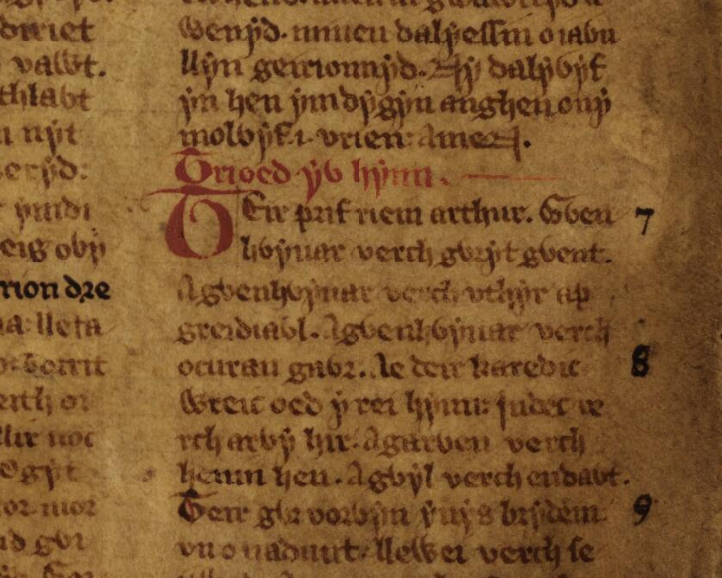
- Peniarth MS 16 (mid-13th century, National Library of Wales): The earliest major collection, with an “Early Version” of about 46 triads, considered pre-Galfridian (before Geoffrey of Monmouth’s influential Historia Regum Britanniae in the 1130s).
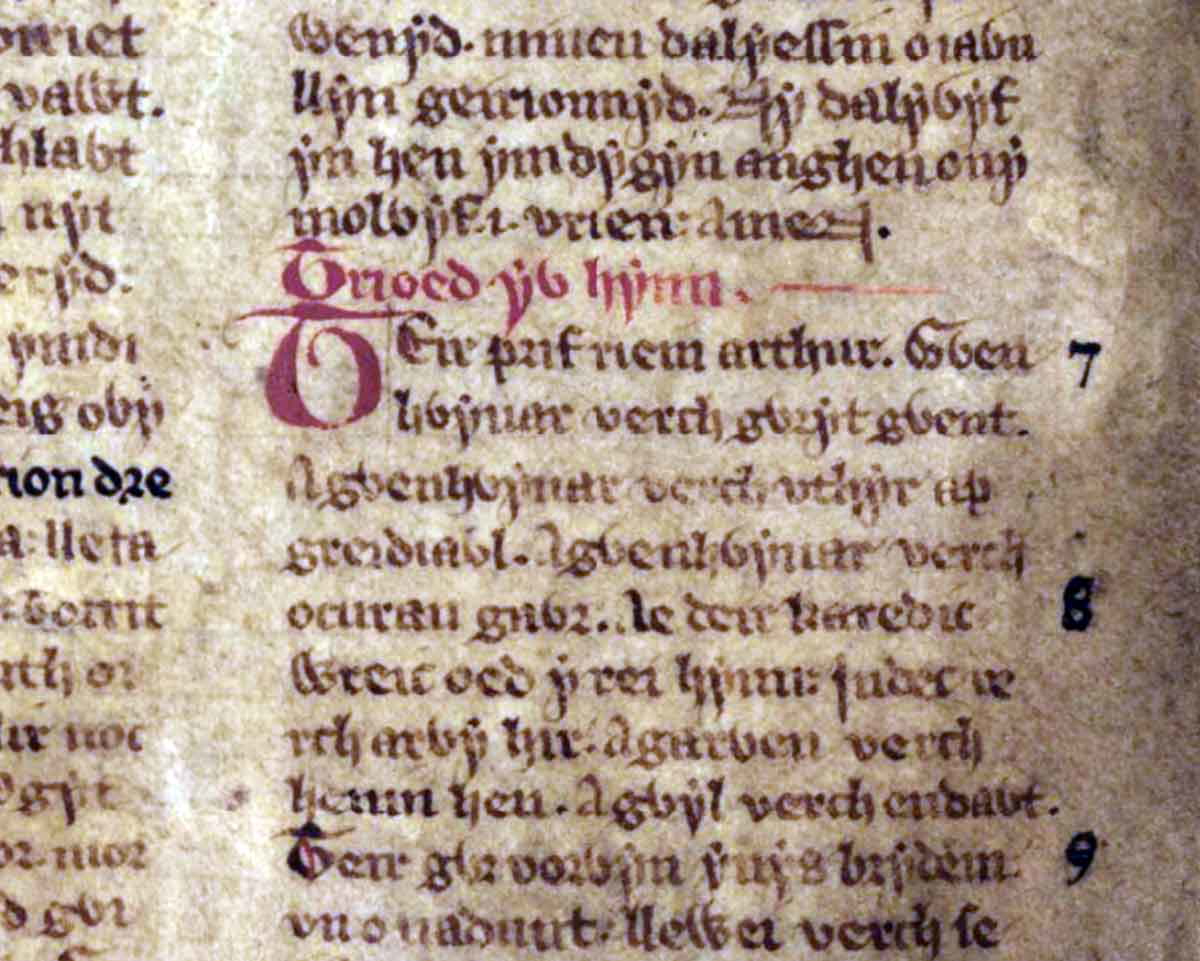
- The White Book of Rhydderch (Llyfr Gwyn Rhydderch, c. 1350): Contains a “Later Version” with around 50 triads, showing some Geoffrey-inspired expansions.
- The Red Book of Hergest (Llyfr Coch Hergest, late 14th century): Expands to about 64 triads, with more Arthurian material.
- Other sources: Scattered in manuscripts like Peniarth 50 (15th century) and embedded in tales like Culhwch and Olwen from the Mabinogion.
The standard modern edition is Rachel Bromwich’s Trioedd Ynys Prydein: The Triads of the Island of Britain (1961, revised 2014), which collates variants and provides translations, notes, and analysis. Arthurian triads often blend historical echoes (e.g., sub-Roman Britain figures) with mythic elements, referencing characters like Gwenhwyfar (Guinevere), Medrawd (Mordred), and Cai (Kay). They influenced later Arthurian literature but were sometimes forged or altered, notably by 18th–19th-century antiquarian Iolo Morganwg (Edward Williams), who invented “third series” triads in works like the Myvyrian Archaiology (1801–1807). These forgeries add romantic glosses and non-medieval details, making them unreliable for authentic study—though some overlap with genuine triads in names and structure.
Manuscript pages like those from the White Book offer a glimpse into how these triads were recorded:

Key Arthurian Triads
Below is a curated list of the most prominent Arthurian triads, drawn from Bromwich’s numbering and manuscript variants (e.g., “WR” for White/Red Book versions). I’ve included the full translated text, variants where relevant, and brief analysis of significance. These highlight Arthur’s portrayal as an exalted yet flawed hero, his court’s dynamics, and ties to broader legends like the Battle of Camlan or his continental campaigns.
| Triad Number & Title | Text & Variants | Analysis & Significance |
|---|---|---|
| 1: Three Tribal Thrones of the Island of Britain | Arthur as Chief Prince in Mynyw (= St David’s), and Dewi as Chief Bishop, and Maelgwn Gwynedd as Chief Elder; Arthur as Chief Prince in Celliwig in Cornwall, and Bishop Bytwini as Chief Bishop, and Caradawg Strong-Arm as Chief Elder; Arthur as Chief Prince in Pen Rhionydd in the North, and Gerthmwl Wledig as Chief Elder, and Cyndeyrn Garthwys as Chief Bishop. | Establishes Arthur as a pan-British ruler with multiple courts, blending Welsh geography (south, west, north) and Christian elements. Reflects his role as a unifying figure in post-Roman Britain; Celliwig is a key Arthurian site in Welsh tales. |
| 2: Three Generous Men of the Island of Britain | Nudd the Generous, son of Senyllt; Mordaf the Generous, son of Serwan; Rhydderch the Generous, son of Tudwal Tudglyd. (And Arthur himself was more generous than the three.) Variant (WR): Similar, emphasizing Arthur’s superiority. | Portrays Arthur as exceptionally benevolent, a common heroic trait in Welsh lore. Links to other figures from the “Old North” (northern Britain), showing Arthur’s integration into wider Celtic traditions. |
| 4: Three Well-Endowed Men of the Island of Britain | Gwalchmai son of Gwyar, and Llachau son of Arthur, and Rhiwallawn Broom-Hair. | Highlights Arthur’s son Llachau (a lesser-known figure, possibly echoing Lancelot motifs) alongside Gwalchmai (Gawain), emphasizing lineage and prowess. Rare familial detail in triads. |
| 9: Three Chieftains of Arthur’s Court | Gobrwy son of Echel Mighty-Thigh; Cad(r)ieith (‘Fine-Speech’) son of Porthawr Gadw; and Fleudur Fflam (‘Flame’). | Focuses on Arthur’s inner circle, underscoring leadership and eloquence. These obscure chieftains suggest lost tales. |
| 12: Three Frivolous Bards of the Island of Britain | Arthur, and Cadwallawn son of Cadfan, and Rahawd son of Morgant. | Depicts Arthur as a bard, adding a cultural layer to his warrior image—unusual but tying into Welsh poetic traditions. |
| 18: Three Battle-Horsemen of the Island of Britain | Caradawg Strong-Arm, and Me(n)waedd of Arllechwedd, and Llyr of the Hosts. Variant (WR): Three Favourites of Arthur’s Court, and Three Battle-Horsemen: they would never endure a PENTEULU over them. And Arthur sang an ENGLYN: These are my Three Battle-Horsemen: and Lludd of the Breastplate, and the Pillar of the Cymry, Caradawg. | Arthur’s knights as independent warriors; the englyn (poem) variant personalizes Arthur as a composer. Caradawg (Caradoc) is a recurring strong-arm hero. |
| 20: Three Red Ravagers of the Island of Britain | Arthur, and Rhun son of Beli, and Morgant the Wealthy. Variant (WR): Rhun son of Beli, and Lle(u) Skilful Hand, and Morgan(t) the Wealthy. But there was one who was a Red Ravager greater than all three: Arthur was his name. For a year neither grass nor plants used to spring up where one of the three would walk; but where Arthur went, not for seven years. | Arthur as a destructive force, symbolizing war’s devastation. The variant hyperbolizes his impact, aligning with mythic exaggeration. |
| 26: Three Powerful Swineherds of the Island of Britain | Drystan son of Tallwch… (full narrative involving Arthur trying to steal a pig); Pryderi son of Pwyll…; Coll son of Collfrewy… Variant (W): Expands on Drystan (Tristan) guarding swine while Arthur, March (Mark), Cai, and Bedwyr fail to steal one. | Connects Arthur to Mabinogion figures like Pryderi; Drystan’s episode foreshadows Tristan-Iseult romance. Shows Arthur’s fallibility. |
| 37: Three Concealments and Three Disclosures of the Island of Britain | The Head of Bran…; The Bones of Gwerthefyr…; The Dragons which Lludd son of Beli buried… Variant (R): Arthur discloses Bran’s head, rejecting magical protection. | Arthur as a pragmatic leader who relies on his own strength; ties to Vortigern (Gwrtheyrn) legends and dragon motif (Welsh flag origin). |
| 47b: Nine Bravest Warriors of the World (Pen. 216 variant) | Includes Arthur among Three Christians, with Ector of Troy, Alexander, etc. | Places Arthur in global heroic pantheon, showing medieval Welsh worldview blending pagan, Jewish, and Christian figures. |
| 51: Three Dishonoured Men | Afarwy…; Gwrtheyrn…; Medrawd (full narrative of betrayal during Arthur’s Roman campaign, leading to Camlan). | Detailed account of Medrawd’s treason and Arthur’s death; echoes Geoffrey but with Welsh twists, like burial on Afallach (Avalon). |
| 52: Three Exalted Prisoners | Llyr…; Mabon…; Gwair… And one more exalted: Arthur (imprisoned thrice, freed by Goreu). | Mythic imprisonment motif; Arthur’s cousin Goreu links to Culhwch and Olwen. |
| 53: Three Harmful Blows | Matholwch upon Branwen…; Gwenhwyfach upon Gwenhwyfar (causing Camlan); Golydan upon Cadwaladr. | Gwenhwyfar’s (Guinevere) slap as Camlan’s catalyst; highlights familial strife in Arthur’s court. |
| 54: Three Unrestrained Ravagings | Medrawd at Arthur’s court…; Arthur at Medrawd’s…; (Aeddan at Rhydderch’s). | Mutual destruction between Arthur and Medrawd; foreshadows Camlan’s betrayal. |
| 56: Arthur’s Three Great Queens (Incomplete in source) | Gwenhwyfar daughter of (Cywryd) Gwent; Gwenhwyfar daughter of (Gwythyr) son of Greidiawl; and Gwenhwyfar… | Suggests polygamy or variant traditions for Guinevere; unique to Welsh sources, contrasting singular queen in later romances. |
Analysis and Broader Context
Arthurian triads depict Arthur as a multifaceted hero: generous beyond peers (Triad 2), a ravager whose footsteps scar the land (Triad 20), and a flawed leader whose absences lead to betrayal (Triads 51, 54). They emphasize themes of honor, conflict, and Britain’s defense against invaders (e.g., Romans, Saxons), blending myth (imprisonments, magical concealments) with pseudo-history. Connections to the Mabinogion (e.g., Branwen, Pryderi) and early poems like Y Gododdin show the triads as an “index” to lost tales. Some scholars link elements like Arthur’s European campaign (Triad 51) to distorted Roman history, such as Magnus Maximus.
Iolo Morganwg’s forgeries expand these, adding triads without medieval basis (e.g., new Arthurian knights or events), often for romantic or nationalist purposes. Authentic triads remain vital for understanding pre-Geoffrey Arthurian lore, influencing modern works like Lloyd Alexander’s Chronicles of Prydain. For further reading, Bromwich’s edition offers exhaustive commentary.